Posts

Showing posts with the label leadership

The Hard Truth About Innovative Cultures

Image
Innovative cultures are generally depicted as pretty fun. They’re characterized by a tolerance for failure and a willingness to experiment. They’re seen as being psychologically safe, highly collaborative, and nonhierarchical. And research suggests that these behaviors translate into better innovative performance.  But despite the fact that innovative cultures are desirable, and that most leaders claim to understand what they entail, they are hard to create and sustain. That’s because the easy-to-like behaviors that get so much attention are only one side of the coin. They must be counterbalanced by some tougher and frankly less fun behaviors: an intolerance for incompetence, rigorous discipline, brutal candor, a high level of individual accountability, and strong leadership.  Unless the tensions created by this paradox are carefully managed, attempts to create an innovative culture will fail. --  Gary Pisano, The Hard Truth About Innovative Cultures , Harv...

Insecurity Breeds Toxicity

Image
"You cannot effectively lead  from a heart of insecurity. Security encourages debate; insecurity fears debate. Security encourages criticism; insecurity fears criticism. Security welcomes diversity; insecurity builds walls. Beautiful challenge of self-awareness today." -- L. D. Buckingham in Zoom conversation with my Launching Your Ministry Class.   Notes from Paige Rouse.

When You've Bitten Off More Than You Can Chew

Image
Occasionally, all of us find ourselves overloaded. Sometimes, it’s the result of circumstances beyond our control. Often, however, it’s because of poor energy/time management on our part. As Momma said, “You’ve bitten off more than you can chew!” This is particularly true for “can do” people with a bias for “yes.” They get a lot accomplished, and occasionally find themselves swamped in the process.   As one of those “can do – bias for yes” people, I’ve found myself in that condition numerous times along the way. I’ve gleaned a few insights from those experiences, and offer a few suggestions to consider when you’ve bitten off more than you can chew. 1)   Ask yourself – “Why am I doing this?” We assume unnecessary responsibilities because we don’t want to disappoint someone, or because we haven’t mastered the art of gracious refusal. If you don’t have a good reason why you’re carrying the load, that’s a good clue that you shouldn’t have picked it up in th...

His Bite is as Bad as His Bark

Image
A man was bitten by a rabid dog and ended up in bed seriously ill.  He  mustered up enough strength to request a pen and a pad of paper.   Then, he began to write furiously -- page after page.  "Honey, are you  writing your last will and testament?" his wife asked.  "No," he  replied, "I'm making a list of people I'm going to bite!"  "His bark is worse than his bite" has been said both of dogs and  grumps.  Unfortunately, there are some people who can pack a pretty  vicious bite.  Perhaps, you have been "bitten" by someone.  Maybe you felt the sting  of gossip or the barbs of unjust criticism.  Such encounters leave us  wounded and in need of emotional first aid.  How do you handle "attack dog people"  -- the ones who snarl and snap  at you, and will take a hunk out of your behind if you turn your back?  1.  Remember, hurting people hurt people.   When they lash out, ...

Understand Your Board

Image
Image from https://www.xpastor.org 1.  Intelligent boards don't mind making complex decisions and they don't want the decision made for them ahead of time. 2.  The higher the engagement and leadership horsepower, the less likely rubber-stamping will be satisfactory.  They will not settle for the first, simple solution.  They need to think it through. 3.  Intelligent boards need good information in order to make good decisions.  This requires a good amount of homework on someone's part, and a clear presentation of options at the meeting. 4.  The best way to frustrate (and lose) intelligent board members is to clog the agenda with trivial non-essentials.  Every meeting should be built around the highest priorities. 5.  Hearty, constructive, debate, expressing differences of opinion is a good way to discover the best answer.  This requires at least some measure of emotional health on the part of all the participants. 6...

When You Have a Big Problem

Image
Having problems? Then be happy, because it means you are alive. The only folks in town with no problems are those in the graveyard who have gone to heaven. Any time you attempt something worthwhile, you're going to run into troubles. They come with the territory of progress. Forward movement always brings friction and resistance. These problems in our lives are there to test our resolve and resilience. Here are a few helpful principles for facing life's difficulties: 1. Big problems are reserved for big people.    The person who desires to go forward with life and aim high will have bigger problems than the one who just sits around doing nothing and watching the world go by.  The rewards are bigger, too -- and definitely worth the struggle. 2. Big plans bring big problems. God gives us the vision of what He can accomplish through us. Sometimes, His vision is accompanies by big plans and big problems. One guarantee: If God supplies the vision, He will put a PR...

What Effective Boards Do Well

Image
After leading or participating in over a thousand board meetings, I've concluded that the most effective boards have figured out how to do the following things well: B --  Believe:   Operate by faith rather than fear.  Prayer for guidance is essential.  When faced with a big challenge, what you do next reveals what you really believe about God. O --  Optimize:   Look for ways build up, strengthen and move forward.  Focus on the possibilities, rather than the problems.  No nit picking or circle spinning. A --  Argue:   Perhaps I should say "argue constructively."  A good board is not just a bunch of rubber stampers.  Neither should it be a collection of cantankerous cranks.  On a healthy board, divergent viewpoints are encouraged and expressed positively.  The best outcomes occur after the various perspectives are weighed.  There's a way to disagree agreeably, keeping the unity of the Spirit in t...

How to Get It Done

Image
I discovered, long ago, that a wish or desire is not enough to get something done. Every accomplishment starts with an idea, of course -- but ideas, alone, won't make things happen. Even a very strong "want to" won't bring the follow through. Getting something done requires doing something ahead of time! 1. What Gets Scheduled Gets Done. A while back, I shared a great vacation idea with my wife, Cathy. "Hey, we should go on a cruise sometime!" "When are you thinking we should do this?" Cathy wondered. "I dunno. Just sometime . . ." Cathy replied, "Well, the only way that's going to happen is if it gets on the calendar." For years, I said I wanted to author a book, but never seemed to have the time to write it. Then, I actually did it. Here's what made the difference. I put" book writing" on my weekly calendar. When I scheduled a definite time to write -- presto -- the book magically appea...

The Secret of Getting Along

Image
It is always more pleasant when people get along. As the Bible says,“Behold how pleasant it is when brothers dwell together in unity.” One mother recently told her children, “I only want one thing for Mother's Day – Just one full day when you all get along with each other without squabbling!” They didn’t make it. (You could say they gave her half-a-present!) Ask anybody, and they will tell you they want to get along with others. However, more often than not, we find ourselves embroiled in controversy of some kind or another. Usually it’s because of misunderstandings. Understanding what frustrates others is the first step towards peaceful relationships. What gets people upset? Abrupt Change: Mark Twain said the only person who likes change is a baby with wet diapers! Normally, however, people are not totally opposed to change. They just get worked up if it is sprung on them! Unclear Expectations: When we assume they know what we’re thinking, we’re asking for trouble. It’s aggravat...

The Only Way to Get There is to Go There

Image
Self examination and difficult conversations are hard.  That's why so few are willing to "go there."  It's painful. "Going there" means humbling yourself enough to face the truth, regardless of how uncomfortable it may be. "Going there" is mustering up the courage to say what needs to be said, even if the other person may not react well to it. "Going there" means caring enough to confront, but often feels uncaring. "Going there" takes the risk that things will never be the same. "Going there" forces you to face your fears. "Going there" reveals your secrets. "Going there" requires looking beneath the actions to the underlying cause. "Going there" shows your shadow self. "Going there" is nerve wracking and gut-wrenching. "Going there" means seeing or hearing things you would rather ignore. "Going there" may make you...

A Parable in Pictures

Image

Resist the Urge to Settle

Image
"Leadership is resisting the urge to settle." says Shannon O'Dell . Otherwise, we will spend our days (weeks, months, years) in the land where the bland leads the bland. We all have the natural inclination to settle into a routine -- also known as a rut.  My daddy used to say, "a rut is a grave with both ends knocked out." As an old church leadership goes:  "Be we high, or be we low, t he Status is the same . . . Quo."

Four Types of Thinkers

Image
There are four different kinds of thinkers in every organization, and they are all equally important. “What If” Thinkers: These are the folks who look for the possibilities rather than the problems.  They are the kind of people that would see something that hasn’t been made yet, and ask, “Why not!”  They creatively seek possibilities, and are quick to see potential.  They look beyond present reality to what could be, and thrive on positive change. Sometimes, “What If” thinkers are criticized for being naïve and unrealistic.  They can exhaust more practically minded people --   but it always takes an idea person to get things launched.  Every great accomplishment starts with a good idea. “Why” Thinkers: “Why” Thinkers look beyond the surface to the deeper meanings.  In order to buy in, they need to understand the reason behind it.  They live on purpose, and are intentional in what they do.  “Why” Thinkers look under...

Four Ingredients for Having a Good Day

Image
Would you like to have a good day?  It's possible. My friend, Stan Toler, recently shared the following insights on the  subject, and  graciously granted me permission to share them with you: Not everyone can have a great day. The sun doesn't always shine.  Factually, the customer isn't always right. The traffic lights aren't  always in sync. BUT, EVERYONE CAN HAVE A GOOD DAY. Let me give you 4  ingredients for having a good day. 1. DO SOMETHING YOU HAVE TO DO. Nothing puts a cloud over a sunny day any more than mind-wrestling a  To-Do list. Go ahead and get crankin’ on that to-do item staring at  you like a mean dog. At least start on it. Take a small step, it may  prompt another. Doing all or part of something that needs to be done  is a push toward the finish. 2. DO SOMETHING YOU LIKE TO DO. Your day isn't complete until you've done something for yourself.  That’s not selfish, it’s actually generous. When you reward yourself...

The Long-Haul Measuring Stick is Character

Image
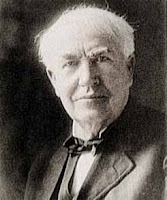
A few years ago, our family visited the birthplaces of two famous Americans on the same day - inventor, Thomas Edison and former president, Warren G. Harding. When we arrived in Milan, Ohio, we immediately noticed that they were proud of their native son, Thomas Edison. A big sign on the edge of the small village proclaimed this was his birthplace. A statue of Edison graced the public square in the center of town. His family home had been restored, with a museum dedicated to his honor. Even the street lights were erected in Edison's memory, as was the Edison Family Restaurant, and the Edison Memorial Methodist Church. Leaving Milan, I remarked that those folks sure were proud of Thomas Edison - especially considering the fact that he moved away in early childhood. A couple of hours later, we arrived in Blooming Grove, Ohio, where Warren G. Harding was born. We were surprised to discover the only thing denoting Harding's birth was an insignificant, faded historical m...

Working Hard vs Hard Work

Image
There is a huge difference between working hard and doing the hard work.  By keeping ourselves busy with overwhelming responsibilities, a multitude of tasks, and packed schedules, we have an excuse for avoiding difficult conversations and hard decisions. If things are sagging, don't defend yourself by pointing out how hard you are working.  Instead, ask yourself whether or not you've been avoiding the hard work.

Are You Running on Positive Juice?

Image
What kind of juice do you have in your tank? Lawnmowers and cars run on gasoline. Chainsaws and weed eaters run on a gas/oil mixture. Sailboats and kites run with the wind. Campfires run on wood -- And you run on one of two kinds of energy: positive or negative (or, more likely, a mixture of both.) What's the difference between running on positive vs. negative juice? 1. Negative juice is the "default" mode. If you don't deliberately  choose the positive path, you'll end up operating in the negative. We  are grumpy by nature -- and cheerful by choice. Nobody is positive by  accident -- It requires a strong commitment and a new way of thinking. 2. Running on negative juice is easier at first -- but much harder in  the long run. Since it is the default mode, you don't have to work at  becoming negative -- it just happens naturally! No extra effort is  required. However, those who operate with negative energy find that  life is much more diff...